Why Keyword Optimization Tools Have Fundamentally Changed in 2026
Before we get to the tools, here is the shift you need to understand. If you have been using keyword research tools for a while, this will feel uncomfortable: most of your current keyword analysis is giving you an incomplete picture of where your customers are actually finding answers.
When a user types “best project management tool for startups” into Google, a traditional keyword planner can tell you how many people search that phrase each month, how competitive it is, and what related queries exist. Useful, but limited. When the same user types the same question into ChatGPT, something entirely different happens. ChatGPT may or may not perform a live web search. If it does, it queries Bing’s index (not Google), generates its own search queries — often quite different from the user’s original phrasing — and then synthesizes a response from what it finds. It might internally search for “top project management software SaaS 2026,” “Asana vs Notion startup reviews,” or “affordable project management tools Reddit.” The user never sees these queries. You never see them either in any traditional tool. But these internal queries are the ones that determine whether your brand gets cited in the final answer.
This is the blind spot that most keyword optimization tools cannot fill. They show you what humans type into search boxes. They do not show you what AI assistants type when they are looking for sources to cite. For AEO and GEO work, that second layer — the AI query layer — is more important than the first. It is the layer that determines your visibility in AI-generated answers, and until 2025 there was no keyword research tool that exposed it directly.
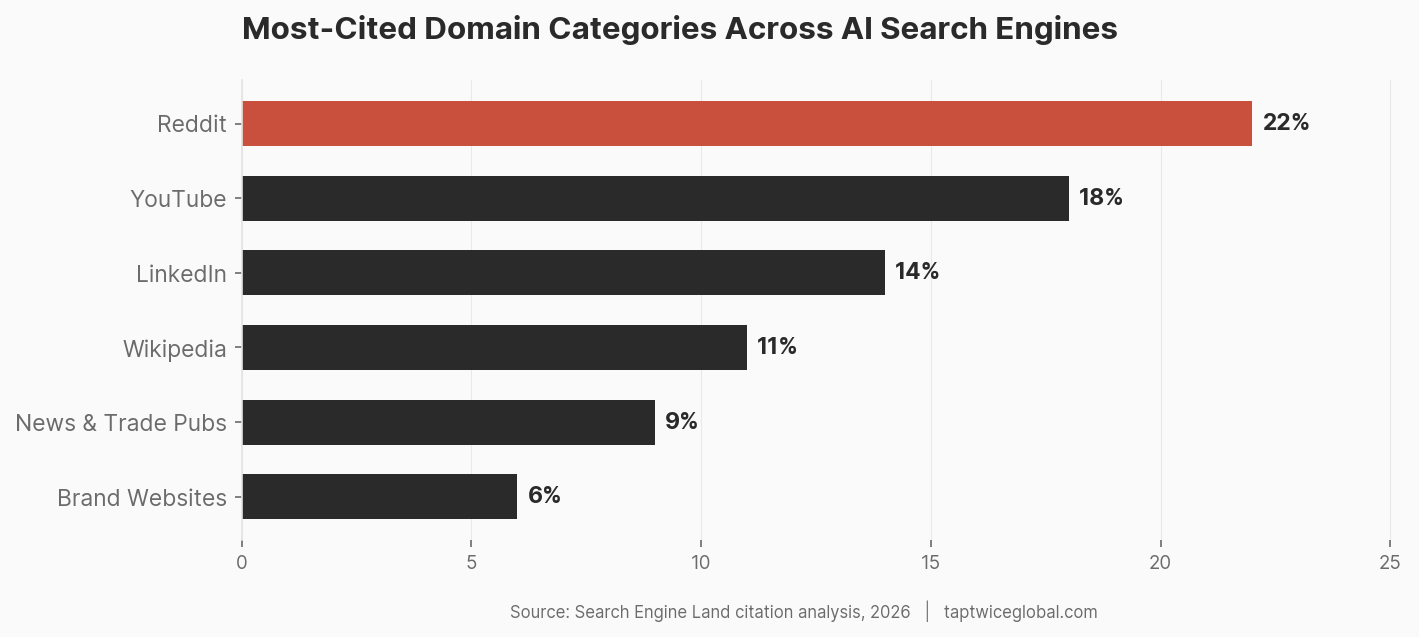
The research backs this up. ChatGPT Search makes Microsoft Bing an SEO priority in ways that traditional SEO strategies were never designed for. Seer Interactive’s analysis of SearchGPT citations found that 87% match Bing’s top-ranked results — meaning if your content is not well-indexed by Bing, ChatGPT’s web browsing literally cannot find you regardless of how well you rank on Google. Similarly, research published on Search Engine Land found that Reddit, YouTube, and LinkedIn are the most cited domains across AI search engines, which reframes what “authority” even means for keyword research.
The eight keyword optimization tools below are grouped by what they do well in this new context. Some are purpose-built for AI search intelligence. Others are traditional keyword research platforms that still provide foundational data you cannot get anywhere else. A complete keyword strategy in 2026 uses both layers — AI search query data and traditional search volume data — because your brand needs to be visible in both Google’s search results and ChatGPT’s conversational recommendations simultaneously. A single-layer keyword optimization approach cannot do that, and brands relying on one layer alone are already losing ground.
1. Rankscale — The AI Keyword Optimization Tool Nobody Else Has
We are leading with Rankscale because it solves a specific problem no other keyword optimization tool on this list solves: it shows you the actual web search queries ChatGPT and other AI assistants perform when answering a prompt. This is genuinely new intelligence. It is not available in Ahrefs, Semrush, Google Search Console, Google Keyword Planner, or any other traditional keyword research software. For AEO and GEO work, Rankscale is the closest thing we have found to reading ChatGPT’s mind when it comes to keyword discovery.
Rankscale was built by Mathias Ptacek, a founder the tool’s reviewers consistently highlight for shipping new features multiple times a week based on community feedback. The platform has grown fast because it targets the exact gap traditional SEO tools left open: visibility into how AI platforms actually find and select sources. According to reviews across G2 and industry blogs, Rankscale achieves an 85-90% match rate with live AI responses during testing — meaning the data it reports is close to what a real user would see if they asked ChatGPT or Gemini the same question.
How Rankscale Actually Works as a Keyword Research Tool
Here is how you use it. You enter a prompt — the kind of question your potential customers would ask ChatGPT. Rankscale runs that prompt through ChatGPT, Gemini, Perplexity, Claude, and Google AI Overviews, capturing each platform’s full response along with the citations each model used. More importantly, for most ChatGPT reports, Rankscale exposes the exact web search queries ChatGPT generated and ran to build its answer. These are not the prompts you entered. They are the internal searches ChatGPT made to find sources worth citing in its response.
Those internal queries are the magic keywords. If ChatGPT searched for “best AI SEO agency for SaaS 2026” to answer a user question about finding an SEO agency, that is the phrase you need your page to rank well for — in Bing specifically, since ChatGPT’s web search runs on Bing’s index. A page optimized for the user’s original prompt (“what AI SEO agency should I use”) is optimizing for the wrong target. A page optimized for ChatGPT’s internal query is optimizing for the phrase that will actually determine whether you get cited.
This reframes keyword research entirely. Instead of guessing what AI assistants are looking for, you can see it directly. Instead of hoping your content matches AI retrieval patterns, you can reverse-engineer the exact patterns and build pages around them. As a keyword optimization tool for the AEO and GEO era, Rankscale addresses something traditional keyword research software simply cannot — because traditional tools were never designed to see AI-layer queries in the first place.
Pricing and Limitations
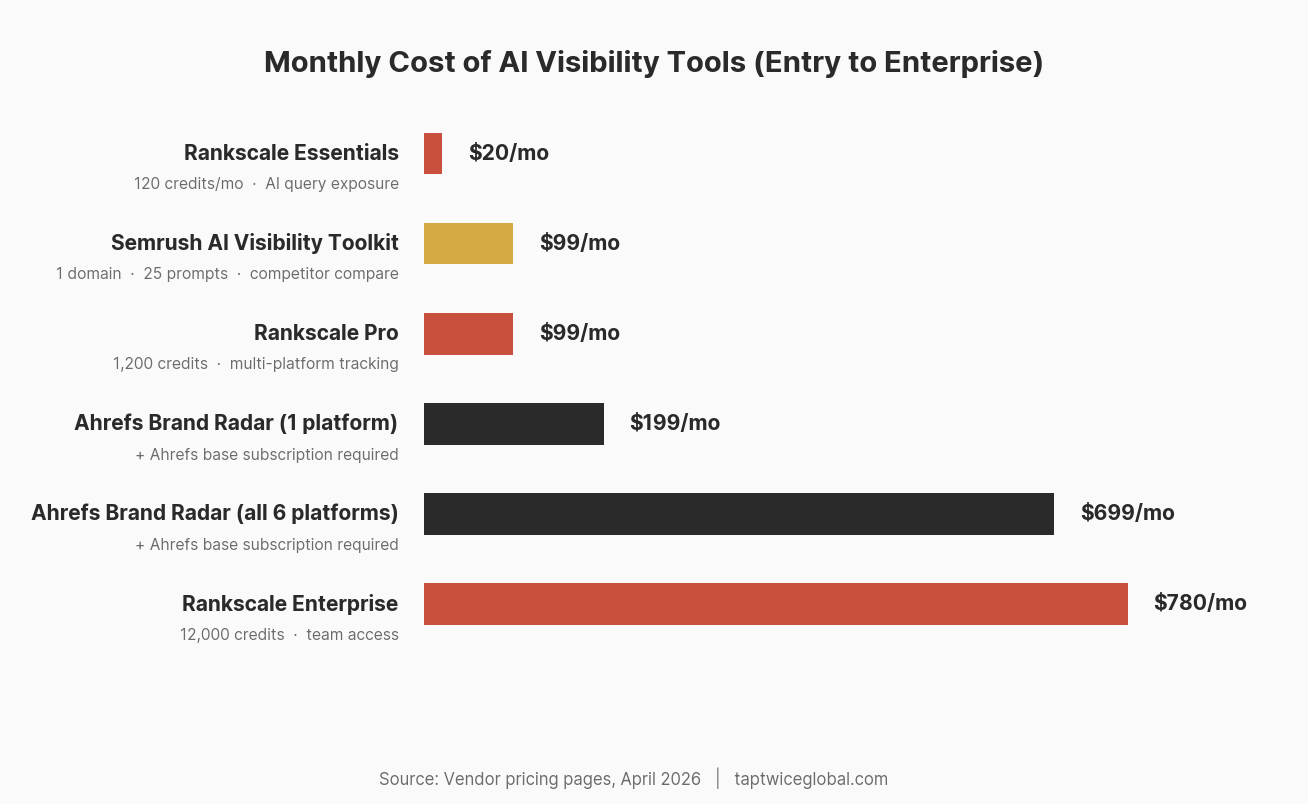
Rankscale uses a flexible credit-based system. Essentials is $20 per month for 120 credits, Pro is $99 per month for 1,200 credits, and Enterprise is $780 per month for 12,000 credits. Each prompt tracking run consumes credits, so if you want broad monitoring across dozens of prompts and multiple platforms, costs can scale quickly. The main limitation, documented in reviews: Rankscale shows you the end result of what AI engines say, but it cannot show you the full path that got them there, and it cannot confirm whether a model ever actually crawled, indexed, or saw a specific page. For verification of whether your content was read, you still need Bing Webmaster Tools or Google Search Console.
Rankscale also tracks brand mention frequency across AI platforms, documents citation sources, and lets you monitor how ChatGPT describes your brand over time. But the web search query exposure is the standout feature — and it is why Rankscale has become part of our standard workflow when we do AI search optimization work for clients. For anyone serious about AEO and GEO, this is the first paid tool we recommend adding to the stack.
2. Google Search Console and Bing Webmaster Tools — The Free Keyword Tracking Tools That Beat Most Paid Ones
No paid keyword optimization tool gives you more accurate data about how your site performs in search than Google Search Console and Bing Webmaster Tools themselves. They are free, they come directly from the source, and they show you the exact queries users typed to find your pages, how many impressions you received, your average position, and your click-through rate. In a world obsessed with AI search, these first-party platforms are easy to undervalue — but they remain the foundation of any serious keyword strategy and the most trustworthy keyword tracking tools available for your own site.
Google Search Console — Still the Ground Truth for Your Google Traffic
The Performance report in Google Search Console is where most of the value lives. Filter by queries, sort by impressions, and you will find keywords you are already ranking for but have not actively targeted. These represent the kind of keyword opportunities that expensive keyword research tools often miss because they are pulling from their own scraped databases instead of your actual search impression data. Filter by pages, sort by position, and you will see which pages are sitting on page two for valuable keywords — a page ranking in positions 11 to 20 is often closer to page-one visibility than a page starting from scratch.
For AEO and GEO work, Search Console also serves as a proxy measurement tool. When your brand starts appearing in AI responses, a predictable pattern follows: branded search volume increases, new query variations appear in the report, and impressions on category keywords grow even when direct clicks do not. Tracking these signals in Search Console gives you an early indicator that your AI visibility work is paying off — even when you cannot measure AI citations directly. Google has also started including AI Overviews and AI Mode appearances in the overall Performance reporting, though there is still no dedicated AI-specific dashboard in Search Console as of April 2026.
Bing Webmaster Tools AI Performance Report — The New Must-Have (February 2026)
In February 2026, Bing launched the AI Performance report in Bing Webmaster Tools as a public preview — and this changes the game for keyword optimization in the AEO era. For the first time, publishers can see exactly how often their content is cited in Microsoft Copilot, Bing AI-generated summaries, and partner AI integrations. The dashboard shows total citation counts, average cited pages, grounding queries, page-level citation activity, and visibility trends over time.
This is the first free tool that gives you direct citation-level data from a major AI platform. Given that ChatGPT’s web search runs on Bing’s index, this data is directly relevant to ChatGPT visibility as well. If your site is not verified in Bing Webmaster Tools yet, fix that today — it takes ten minutes and it unlocks visibility data you cannot get anywhere else. Google Search Console handles the traditional search layer. Bing Webmaster Tools now handles the AI citation layer. You need both, properly configured, before any paid keyword research tool will give you meaningful value.
3. Google Keyword Planner — Free Search Volume Data Directly from Google
Google Keyword Planner is buried inside Google Ads, which means you need an Ads account to use it. But unlike most of the paid keyword research tools, this keyword planner pulls its data directly from Google’s own search records. When accuracy matters — when you are making decisions about which keywords to invest content resources in — Keyword Planner is the most reliable source for Google search volume available at any price point.
The caveat is well-known and still applies in 2026: without an active Google Ads campaign spending real money, Keyword Planner shows you search volume in broad ranges (1K–10K, 10K–100K) instead of exact numbers. Running even a minimal Ads campaign — as little as $5 to $10 per day for a short period — unlocks the precise monthly average search volume for your keywords. That is Google’s way of keeping the precise data behind a paywall, and it has not changed. For most keyword research decisions, the ranges are good enough. If you are deciding between two keyword variations and one shows “1K–10K” while the other shows “100–1K,” you have your answer without needing exact numbers.
A limitation worth knowing: Google Keyword Planner aggregates similar keywords together, so searches for “keyword search volume tool” and “keyword volume checker” may be reported under a single combined figure. This means the reported volume can overstate a single keyword’s actual demand. Cross-checking with Ahrefs or Semrush (which report per-variant volume) is a common workflow for keywords where precise numbers matter for content prioritization.
Where Keyword Planner excels is in discovery. Enter a seed keyword and it will return hundreds of related terms with volume estimates, competition scores, and suggested bid ranges. For a keyword researcher building a topic cluster from scratch, this is the fastest keyword discovery workflow available from a free tool. For AEO and GEO work, use it to identify the informational queries in your niche — the “how,” “what,” “why,” and “is it worth” questions that AI assistants are most likely to answer conversationally. These are the queries where your content has the highest chance of being extracted and cited as a source.
4. Google Trends — The Keyword Timing Tool Most SEOs Underuse
Every other keyword optimization tool on this list tells you what people are searching for right now. Google Trends tells you whether that interest is growing, declining, or seasonal — and that timing layer matters more than most marketers realize.
A keyword with 10,000 monthly searches that has been declining steadily for two years is a trap. By the time your content ranks, the audience will have moved on. A keyword with 500 monthly searches that has tripled in the past six months is an opportunity. Early content on rising topics captures the growth curve, and early AI citation accumulation compounds over time. Google Trends is the only free keyword research tool that gives you this directional data reliably, and in 2026 its “Trending Now” forecasting engine updates every 10 minutes thanks to the infrastructure update from late 2024 — meaning you can detect emerging trends in their earliest stages rather than waiting for daily aggregates.
One thing to understand about Google Trends: it does not provide absolute search volumes. It normalizes search interest on a 0-100 scale relative to the highest point in your selected time range. This is useful for trend direction but not for absolute comparison. For absolute numbers, you need Keyword Planner or a paid tool like Ahrefs or Semrush. Browser extensions like Glimpse can overlay absolute estimates on Google Trends charts, which is a common workaround among keyword researchers who need both the timing layer and approximate volume in a single view.
The comparison feature is where Google Trends becomes a keyword optimization tool rather than just a curiosity. Type in your brand name alongside two or three competitors and you can see the relative interest curves across years. This is a crude but useful proxy for AI visibility — when AI assistants start recommending a brand more often, Google Trends usually shows a corresponding lift in branded search volume a few weeks later. If your brand curve is flat while a competitor’s is climbing, you are losing ground in AI answers even if you cannot measure those answers directly. For AEO measurement specifically, Google Trends is one of the free proxy signals we use to validate whether AI visibility improvements are translating into real-world demand.
For emerging topics in AI search, LLMs, and generative optimization — the space where AEO and GEO work unfolds — Trends shows you when terminology is catching on. The terms “AEO,” “GEO,” “LLMO,” and “answer engine optimization” have all shown distinct rising patterns over the past two years. Writing content for these rising terms early, before traditional keyword research tools pick them up with reliable volume data, is how you establish authority in categories before they become competitive.
5. Perplexity with Source Filters — The Best Question Discovery Tool for Keyword Research
Perplexity is an AI search engine, but we are including it in this list of keyword optimization tools because it is also one of the best question discovery platforms available — if you use its source filtering feature correctly.
Here is the trick most users miss. Perplexity lets you pre-filter sources before searching. You can set the source filter to “Social” to scour Reddit and community discussions, switch to “Academic” to bypass marketing hype and see only published papers, or target specific high-authority domains. This is not a hidden feature — it is built into Perplexity’s interface — but most people run it with default settings and never realize how powerful the filter becomes for keyword research.
When you set the source filter to Reddit (or the broader Social filter) and ask Perplexity questions like “what questions do people ask about [your category]?” or “what problems do [your target customer] face with [your category]?”, Perplexity synthesizes actual Reddit conversations, real pain points, and real questions from people who were trying to solve the exact problem your product addresses. These are not hypothetical keyword suggestions from an algorithm. They are actual human questions, phrased the way humans phrase them when they are frustrated, curious, or looking to buy.
One note about Perplexity in 2026 that most articles miss: following a lawsuit filed in October 2025, Perplexity’s Reddit citations have decreased significantly compared to previous years. Reddit remains one of Perplexity’s source pools, but the balance has shifted toward other community platforms and news outlets. This does not break the keyword research workflow — it just means you should occasionally check which sources Perplexity is actually pulling from in your niche, rather than assuming it is always pulling heavily from Reddit specifically.
Why does this matter for AEO and GEO specifically? Because community platforms remain among the most heavily cited sources across major AI platforms. Research from Search Engine Land found that Reddit, YouTube, and LinkedIn are the most cited domains in AI search engines. When ChatGPT or Perplexity answers a question, it is often pulling from these conversational platforms. If your content uses the same phrasing that appears in those community threads — the actual questions real people ask — you increase the probability that AI assistants will cite you as a source alongside the community discussions they already trust.
Perplexity with the Social source filter is also the fastest way to discover long-tail question keywords that traditional keyword tools miss entirely. A keyword analysis tool will tell you that “best CRM” is searched 40,000 times a month. Perplexity filtered to Reddit will tell you that people are actually asking “is HubSpot worth it for a three-person sales team or should I just use a spreadsheet?” — a question no keyword research software will surface but one you can build content around with much higher ranking probability because the competition for that specific phrasing is essentially zero.
6. ChatGPT Deep Research with Restricted Sources
ChatGPT Deep Research was introduced as an AI agent that autonomously browses the web for 5 to 30 minutes, finds hundreds of sources, and synthesizes a structured report. It was designed for investigative work — academic research, market analysis, due diligence. That same capability makes it a surprisingly effective keyword research tool when you direct it at the right sources.
In February 2026, OpenAI added an important feature to Deep Research: you can now connect it to MCP (Model Context Protocol) servers and restrict its web searches to trusted sites. This means you can force Deep Research to focus its analysis on specific communities, publications, or industry sources rather than letting it browse the entire web with no filter. For keyword research aimed at understanding community language, this is a significant improvement over the earlier version.
Using Deep Research for Keyword Intelligence
Use Deep Research to ask questions like: “What are the most common questions people ask about [your topic] on Quora and Reddit over the past 12 months, and what specific pain points come up repeatedly? Cite specific threads and examples.” Let it run for 5 to 10 minutes. What you get back is not a keyword list — it is a structured analysis of the actual conversations happening in the places your potential customers hang out. Deep Research will pull from specific Quora threads, cite Reddit comments, and often surface niche forums you did not know existed.
The advantage over traditional keyword research tools is depth. A keyword planner gives you a flat list of terms. Deep Research gives you context — why people are asking the question, what frustrates them about existing solutions, how they describe the problem in their own words, and which answers they find satisfying. That context is what lets you write content that matches search intent precisely instead of just matching search terms. For serious keyword intelligence work, that qualitative layer is as valuable as the quantitative data from traditional tools, and Deep Research delivers it with citations you can verify manually.
For AEO and GEO work, Deep Research is particularly useful for building “Information Gain” content — pages that answer questions no other source answers well. When Deep Research shows you a pattern of questions that have only unsatisfying answers in existing forums, that gap is a citation opportunity. Write the definitive answer, publish it with clear structure, and AI assistants will start pulling from your page instead of the incomplete forum threads they were previously citing. This is one of the few reliable paths to AI visibility for newer brands that do not yet have the backlink authority of established competitors.
7. Ahrefs — The Most Complete Competitive Keyword Research Platform
Ahrefs is expensive and it is traditional SEO software at its core. Both of those things are fair criticisms. But for competitive keyword research — understanding what your competitors rank for, what content they publish that drives traffic, and what gaps exist in their coverage — Ahrefs is still the most complete keyword research platform available in 2026. And with the launch of Brand Radar in 2025 and the addition of custom AI prompt tracking in January 2026, Ahrefs has expanded into AI visibility monitoring in a way that matters for keyword strategy.
Traditional Keyword Research Capabilities
The Keywords Explorer shows you search volume, keyword difficulty, click potential, and SERP history for any query. That last feature is underrated: SERP history lets you see how a keyword’s top results have changed over time, which is often where the best opportunities hide. A keyword where the top ten results have churned recently is a keyword where new content has a real chance to break in. This kind of SERP analysis is something most free keyword tools cannot match.
The Site Explorer is where Ahrefs earns its price for competitive research. Enter a competitor’s domain and you can see every keyword they rank for, the pages that drive their organic traffic, and the backlinks pointing to their best-performing content. For AEO and GEO work specifically, this reveals something valuable: the pages that rank well on Google are often the same pages getting cited in AI Overviews and ChatGPT responses, because AI retrieval tends to pull from the top-ranking results of the underlying search index. Finding your competitor’s top-performing pages and understanding why they rank is the fastest way to identify the content structures AI assistants prefer in your niche.
Brand Radar and Custom AI Prompt Tracking
Ahrefs Brand Radar is a newer addition that tracks brand visibility across six AI platform indexes: Google AI Overviews, Google AI Mode, ChatGPT, Perplexity, Gemini, and Copilot. In January 2026, Ahrefs added custom AI prompt tracking to Brand Radar, letting teams monitor how their brand appears in AI-generated answers for specific prompts they define themselves. Brand Radar also tracks YouTube, TikTok, and Reddit visibility, with Reddit tracking appearing specifically within Google Search context.
Pricing for Brand Radar is significant: $199 per month per individual AI platform index, or $699 per month for access to all 6 platforms bundled together, and it requires an active Ahrefs base subscription. Reviews note the data sampling captures only a fraction of actual AI conversations — meaning it gives directional insight rather than comprehensive tracking. For pure AI-query discovery, Rankscale remains the more targeted tool. But for teams that need AI visibility monitoring layered on top of their existing Ahrefs workflow for keyword research and competitive analysis, Brand Radar is the most integrated option currently available.
The Content Gap tool finds keywords your competitors rank for that you do not. In competitive markets, this is where the quickest wins live. If three competitors all rank in the top ten for a keyword and you do not rank at all, that is a keyword you can probably rank for with a well-executed piece of content — and a keyword AI assistants are likely to surface for citation. For teams that need a keyword opportunity finder grounded in competitive data, Ahrefs remains the benchmark in 2026.
8. Semrush — The Most Useful Keyword Optimization Tool for Content-Level Mapping
Semrush and Ahrefs overlap significantly in capabilities. Many SEO teams use one or the other based on preference. We include Semrush separately because it has two features that are particularly useful for the kind of content-driven keyword research AEO and GEO require — plus a dedicated AI Visibility Toolkit that launched in 2025 and has matured into a capable standalone product.
Keyword Magic Tool and Topic Research
The first feature worth highlighting is the Keyword Magic Tool, which breaks any seed keyword into topic groups and question variations in a single view. If you enter “AI search optimization,” the tool will return everything from high-level category keywords to specific long-tail questions to modifier variations (“best,” “how to,” “vs”) in an organized structure. That structure makes it fast to plan a complete content cluster around a topic instead of researching keywords in isolation. For teams using a keyword mapping workflow, this single view is worth the subscription alone.
The second is the Topic Research tool, which is designed for content strategy rather than pure keyword mining. Enter a topic and Semrush returns subtopics, questions, related searches, and example headlines from already-ranking content. For writers building AEO and GEO content, this is the closest thing to a complete briefing document you can get from an automated tool — and it dramatically cuts the time from keyword research to publishable first draft.
Semrush AI Visibility Toolkit
The Semrush AI Visibility Toolkit costs $99 per month as a standalone add-on or as part of the main Semrush subscription, and includes one domain for brand performance analysis plus 25 prompts for tracking. It measures your mention frequency and citation counts across ChatGPT, AI Overview, AI Mode, and (per Semrush’s own roadmap) Gemini as support rolls out. The Brand Performance report tracks your brand’s share of voice and sentiment across AI platforms, showing which questions trigger mentions of your business and whether the sentiment is positive, neutral, or negative.
Competitor Research within the AI Visibility Toolkit lets you directly compare your AI visibility against up to four competitors at once, with side-by-side metrics for mentions, citations, and topic coverage. AI Readiness Audits are built into the site audit feature, so you can identify technical and structural issues that block AI systems from understanding your pages before they hurt your citation probability.
The Position Tracking feature now includes tracking for Google AI Overviews in many regions — one of the few ways to monitor AI Overview appearances for your target keywords without building a custom tracking system. For a single keyword optimization tool that bridges traditional SEO keyword research and emerging AI search intelligence, Semrush is the most integrated option available in a single subscription as of April 2026.
One caveat worth mentioning based on user reviews: Semrush scores well on G2 and Capterra (4.5-4.6 out of 5 across thousands of reviews) but drops significantly on Trustpilot (2.4 out of 5), with most complaints about billing and cancellation rather than the software itself. Budget accordingly and set calendar reminders if you are planning to downgrade or cancel.
How to Actually Use These Keyword Optimization Tools Together
Eight keyword optimization tools is too many to use daily. The point of this list is not that you need all of them — it is that different tools solve different parts of the AEO and GEO keyword research problem, and a serious strategy uses the right tool for each layer.
In practice, our workflow at Taptwice Global looks like this. We start with Rankscale to understand what AI assistants are actually searching for when users ask questions in our clients’ categories. This produces a list of “AI-layer” queries — the phrases that matter for citation, not just for Google ranking. Then we use Perplexity with Social source filters and ChatGPT Deep Research with restricted sources to understand the language real people use when they discuss these topics in forums. This gives us the phrasing patterns that match how AI assistants synthesize answers from community context.
With both lists in hand, we go to Ahrefs or Semrush to find the competitive landscape — which pages already rank for these terms, what content structures are working, and where the gaps exist. Google Keyword Planner provides search volume sanity checks for the highest-priority keywords, and Google Trends tells us whether the topic is rising or declining. Finally, Google Search Console and Bing Webmaster Tools AI Performance Report track the results — the traditional search impressions in Search Console, the AI citation data in Bing Webmaster Tools, and the branded query lift across both platforms as a secondary signal of AI visibility improvements.
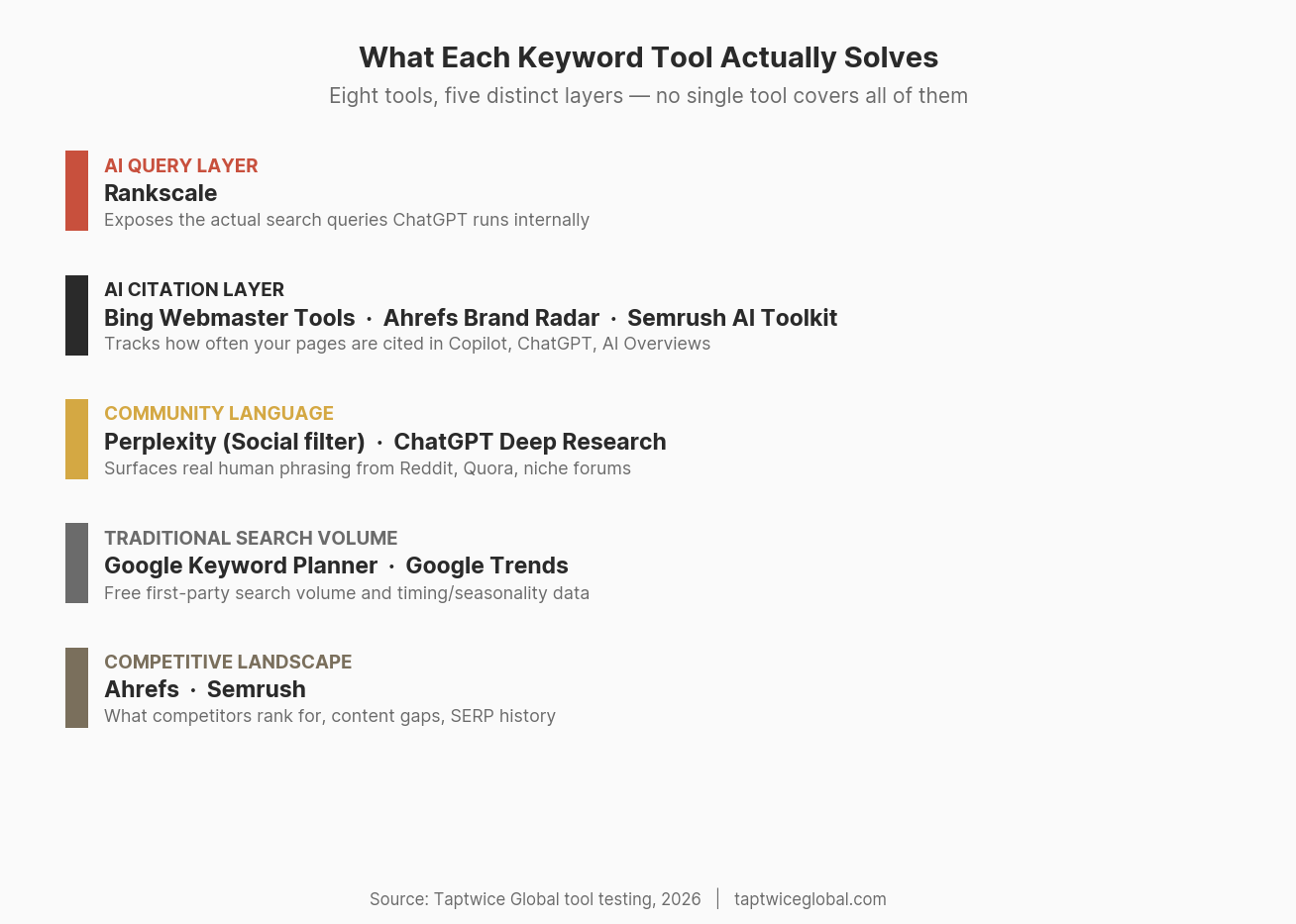
None of these keyword optimization tools alone would give us a complete picture. Rankscale shows the AI query layer. Traditional SEO tools (Ahrefs, Semrush) show the Google ranking layer. Perplexity and ChatGPT Deep Research bridge the gap by showing the conversational community layer where AI assistants source their real-world context. Google Search Console shows Google’s reporting layer. Bing Webmaster Tools now shows the AI citation layer directly. Using all these layers together is what separates effective 2026 keyword research from the outdated approach that is still being sold as “SEO keyword research software.”
What We Left Out and Why
We tested over thirty keyword optimization tools to build this list. Most did not make it. A few explanations are worth giving so you understand why some popular tools are absent.
Many “AI SEO” keyword tools are really traditional keyword research platforms with a ChatGPT wrapper on top. They use GPT to reformat keyword lists, generate content briefs, or suggest variations. None of this is fundamentally new. If the underlying data is still pulled from traditional search indexes, the tool does not help you understand AI-layer queries — which is the whole point of adding AEO and GEO to your keyword research workflow. Surfer SEO, Frase, and a number of content optimization platforms fall into this category. They are good at what they do, but they are not solving the AI-query gap.
Several dedicated AI rank tracking tools like Profound, Scrunch, AthenaHQ, Peec AI, and Bluefish are strong products, and some of them would be candidates for a list focused purely on enterprise AI visibility monitoring. We excluded them from this list because the brief is “keyword optimization tools” — tools that help you discover, analyze, and act on keywords. Pure rank tracking platforms, while valuable, overlap heavily with what Rankscale and Ahrefs Brand Radar already cover at different price points.
Free keyword research tools like Ubersuggest, Keywords Everywhere, and AnswerThePublic have specific use cases but did not make this list because their data is less reliable than the combination of Search Console and Keyword Planner, and they do not address the AI-layer gap that Rankscale solves. AnswerThePublic in particular is a useful question discovery tool but Perplexity with source filters does the same job with live data from current community conversations.
The keyword optimization tools that made the final eight are the ones we actually use in client work. They are not always the most expensive. They are not always the most hyped in 2026 launch announcements. They are the ones that, in our experience, consistently produce the research foundation for content that both ranks in Google and gets cited in AI responses. For any business serious about AI search optimization and broader entity SEO work, building a workflow around these eight keyword research tools is the fastest way to start producing content that moves the needle in both traditional search and AI-generated answers.
Frequently Asked Questions
What is the best keyword optimization tool for AEO and GEO in 2026?
Rankscale is the only keyword optimization tool we tested that exposes the actual web search queries ChatGPT performs when answering prompts. That visibility is specifically useful for AEO and GEO because it shows you the phrases that determine citation probability, not just the phrases users type. For a complete keyword research strategy, pair Rankscale with Perplexity (filtered to Social or Reddit sources), ChatGPT Deep Research (with restricted sources), and the new Bing Webmaster Tools AI Performance Report. No single keyword optimization tool gives you every layer — but Rankscale is the one tool that solves the AI-query gap no other platform addresses directly.
Do I still need Ahrefs or Semrush if I am optimizing for AI search?
Yes. AI assistants pull from the live web, and the pages they pull from are usually pages that already rank well on traditional search engines. Seer Interactive’s research found that 87% of SearchGPT citations match Bing’s top results — meaning if your content does not rank well in the underlying search index, AI platforms cannot cite it regardless of how well-structured it is. Ahrefs and Semrush are still the most reliable keyword research platforms for understanding what ranks, why it ranks, and where the gaps are. Skipping traditional SEO keyword research is one of the most common mistakes we see brands make when they first try to optimize for AI search. A good 2026 keyword strategy combines an AI-first keyword tool like Rankscale with a traditional competitive keyword research platform like Ahrefs or Semrush.
Is Google Keyword Planner accurate without a paid Ads account?
Keyword Planner shows search volume in broad ranges instead of exact numbers unless you have an active campaign spending money. For most keyword research decisions, the ranges are accurate enough to make good choices. If you need exact numbers, running even a small Ads campaign (as little as $5-10 per day) unlocks the precise data for the duration of the campaign. Be aware that Keyword Planner also aggregates similar keywords together, so the reported volume may combine several close variants into a single figure — cross-check with Ahrefs or Semrush when precise per-variant numbers matter for content prioritization decisions.
How does Perplexity work as a keyword research tool?
Perplexity is primarily an AI search engine, but you can use it as a keyword research tool by filtering your source to Social (which includes Reddit) and asking questions like “what questions do people ask about [your topic]?” or “what problems do [your target customer] face with [your category]?” The answers come with citations to specific community threads, giving you real human questions in real human language. For AEO work, this is one of the fastest keyword discovery workflows available — it surfaces long-tail question keywords that traditional keyword research software cannot find. Note that following a lawsuit in October 2025, Perplexity’s specific Reddit citation frequency has decreased compared to previous years, though community platforms overall remain heavily represented in its sourcing.
Is the new Bing Webmaster Tools AI Performance Report worth setting up?
Absolutely, and it is free. Launched as a public preview in February 2026, the Bing Webmaster Tools AI Performance Report is the first free tool that shows you citation-level data from a major AI platform. It tracks how often your content is cited in Microsoft Copilot, Bing AI-generated summaries, and partner AI integrations, with page-level citation activity, grounding queries, and visibility trends. Given that ChatGPT’s web search runs on Bing’s index, this data is also directly relevant to ChatGPT visibility. If your site is not yet verified in Bing Webmaster Tools, set it up today — it takes ten minutes and unlocks data you cannot get from any paid tool.
Can I use only free keyword optimization tools and still do effective keyword research in 2026?
For most businesses, yes — but only if you are willing to do more manual work. Google Search Console, Bing Webmaster Tools (including the new AI Performance Report), Google Keyword Planner, Google Trends, Perplexity, and ChatGPT free tiers cover most of what you need. The paid keyword tools (Rankscale, Ahrefs, Semrush) save time and provide capabilities the free tools cannot replicate, particularly around AI-layer query discovery and competitive intelligence. For a small business starting from zero, the free keyword research stack is enough to build a foundation and produce content that ranks and gets cited. For competitive markets or serious AEO and GEO work, the paid keyword optimization tools pay for themselves quickly through the time they save and the insights they surface.
What is the single biggest mistake people make with keyword research for AI search?
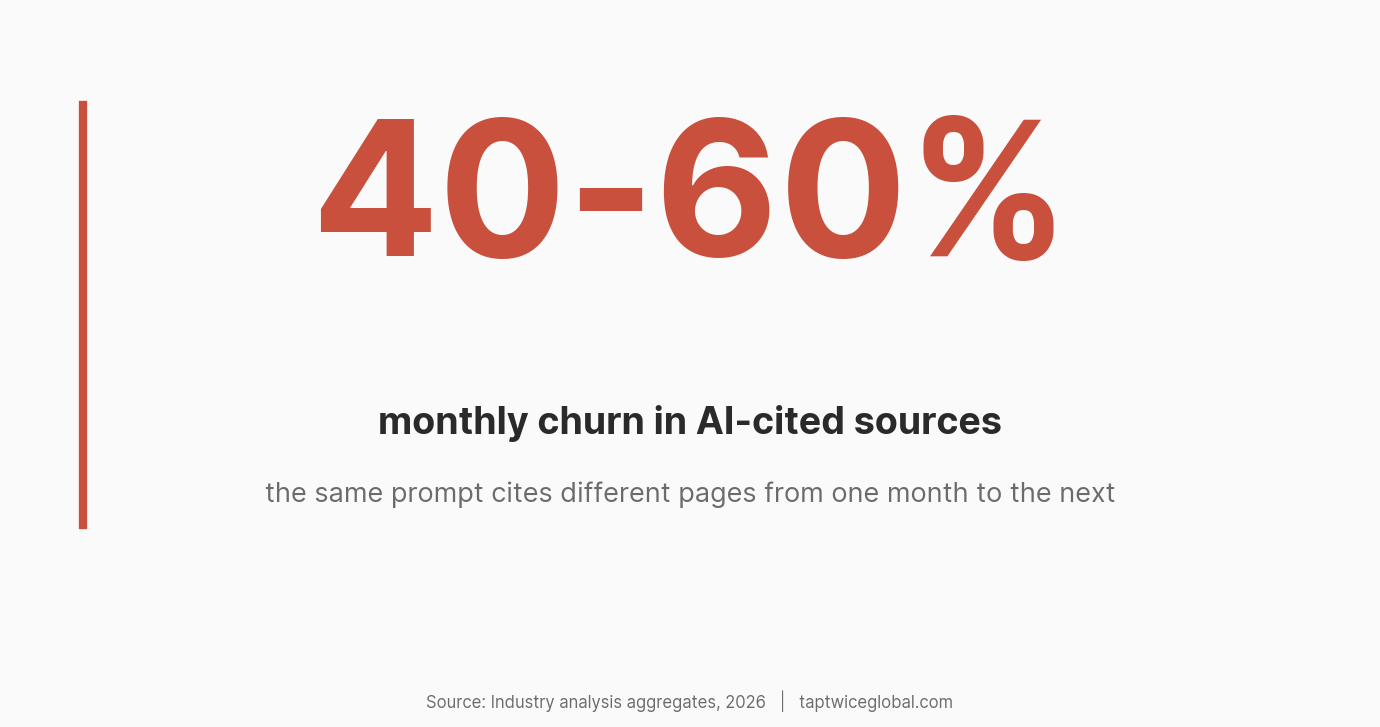
Assuming that the queries users type into ChatGPT are the same queries ChatGPT uses to find sources. They are not. When a user asks ChatGPT “what is the best SEO agency,” ChatGPT may internally search for something completely different — a more specific phrase, a comparison query, or a category-level search. Optimizing for the user’s original phrasing is optimizing for the wrong target. The queries that matter are ChatGPT’s internal searches, which is exactly what Rankscale exposes and which no other keyword optimization tool on this list shows directly. Combine that insight with the fact that 40-60% of AI-cited sources change month-to-month (compared to the relative stability of traditional Google rankings) and you have the full picture of why keyword research for AI search requires a different toolkit than SEO keyword research ever did.
Which keyword optimization tool should I start with if I can only choose one?
If you have no keyword optimization tool at all, start with the free stack: Google Search Console plus Bing Webmaster Tools (with the AI Performance Report enabled) plus Google Keyword Planner. This combination is free, it covers traditional search data, it now includes direct AI citation tracking from Bing, and it gives you the foundation every other tool builds on top of. If you already have those configured and are choosing your first paid tool for AEO and GEO work, Rankscale is the most valuable single addition because it solves a problem no free tool and no traditional paid keyword research software addresses: visibility into AI-layer queries. If your priority is competitive research on traditional search rankings rather than AI visibility specifically, Ahrefs or Semrush would be the better first paid tool for that use case.